


Jun 04 , 2026
A B2B Sourcing Insight: Biaxially Oriented Polypropylene Solutions Engineered for Tropical Sunlight and High-Intensity Retail Environments
When selecting substrates for long-haul cross-border logistics and consumer flexible packaging, corporate procurement teams often overlook a fatal environmental stressor: solar radiation. In hot, high-sunlight export regions—such as Latin America and Southeast Asia—standard BOPP (Biaxially Oriented Polypropylene) films frequently suffer from premature aging. This manifests as bleached or faded printing, hazy or yellowed substrates, and catastrophic pouch failure driven by a sharp drop in tensile strength. This technical oversight in material selection directly degrades on-shelf brand image, shortens product shelf life, and triggers costly international damage claims and disputes.
Throughout our years of serving the global packaging market, we have witnessed countless major product returns and losses caused by a simple failure to account for UV degradation. The definitive solution to this pain point lies in utilizing premium, material-level modified BOPP films engineered with dedicated anti-UV capabilities.
When standard, non-UV-protected flexible plastic packaging enters high-solar regions, the pouches often look worn, faded, and weathered before the product is even sold. Faded printing and washed-out colors rapidly trigger consumer complaints and erode brand trust.
High-energy ultraviolet radiation within sunlight directly attacks the backbone of the polypropylene molecular chain, generating highly destructive free radicals within the material. These free radicals trigger a cascading, autocatalytic photo-oxidative reaction. Physically and optically, this reaction leads to severe yellowing, loss of surface gloss, embrittlement, a catastrophic drop in tensile strength, and the formation of microscopic surface cracks.
Backed by the robust R&D capabilities of our publicly listed parent company, the BOPP Division at FULI New Materials has developed a next-generation UV-stabilized formulation. Our engineered films are custom-built for long-haul cross-border supply chains, flawlessly enduring the complex, extreme solar and climatic zones of markets like Mexico, Brazil, Vietnam, Thailand, Malaysia, India, Indonesia, Turkey, and Russia.
Performance Metric | Standard Commodity-Grade BOPP Film | High-Performance UV-Resistant BOPP Film | Realized Commercial Value |
Color Retention | Severe fading and bleaching occurs within 3 to 6 months of exposure. | Maintains vibrant colors and crisp graphics for over 12 months. | Preserves a premium, unified brand image on the retail shelf. |
Mechanical & Tensile Strength | Strength drops sharply post-exposure, making the film highly prone to tearing. | Long-term retention of excellent toughness, flexibility, and impact resistance. | Eliminates pouch breakage during high-speed automated filling and transit. |
Yellowness Index (YI) | Spikes rapidly; the substrate becomes hazy, dull, and aged. | Suppressed to near-zero levels; remains optically clear and transparent. | Ensures excellent product visibility and a clean, premium aesthetic. |
Outdoor / High-Brightness Shelf Life | Highly restricted; prone to early material failure. | Significantly extended outdoor and shelf life in high-radiation environments. | Radically reduces return disputes and claims from overseas buyers. |
Total Cost of Ownership (TCO) | Lower initial material cost, but burdened by extremely high product loss rates. | Slightly higher initial cost, but long-term product waste drops to near zero. | Significantly reduces product shrinkage across the entire supply chain. |
Tailoring a flawless UV-resistant flexible packaging solution for global export markets requires tier-1 manufacturers to tightly control specific technical variables during production:
Substrate Film Thickness: Under identical additive ratios, a thicker film profile naturally provides a deeper physical barrier, effectively slowing down the rate at which free radicals penetrate and diffuse into the core of the material.
Synergistic Additive Formulations: The secret lies in the precise, scientific ratio between UV Absorbers (which screen and convert harmful wavelengths of light energy) and Hindered Amine Light Stabilizers (HALS) (which continuously scavenge free radicals and terminate the photo-oxidation chain).
Molecular Homogeneity in Large-Scale Extrusion: The biaxial orientation process demands extreme, molecular-level precision. At FULI New Materials' modern 160,000 ㎡ manufacturing hub—backed by an initial 2021 investment of 1.6 billion RMB—we utilize advanced, large-scale production lines to ensure additives are dispersed with absolute uniformity across the film matrix, guaranteeing batch-to-batch consistency.
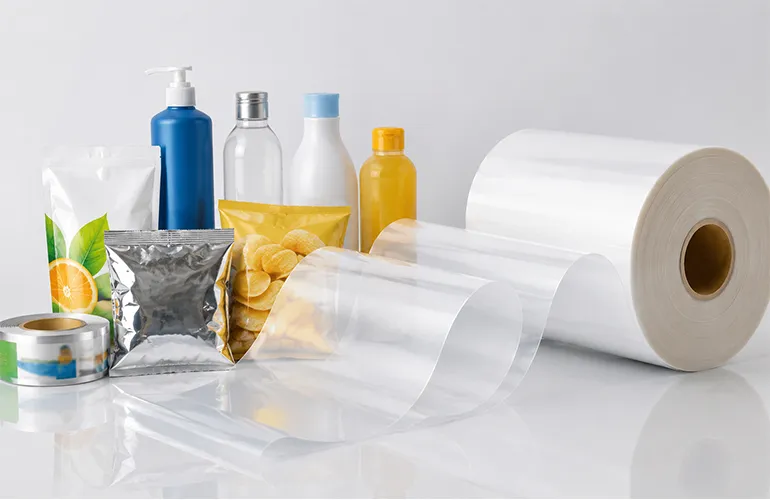
While locking in high-saturation print colors, UV-resistant BOPP films effectively prevent the degradation or oxidation of internal contents caused by light exposure, significantly slashing supply chain shrinkage. FULI New Materials offers a comprehensive portfolio of UV-stabilized solutions, including Pearlized, Matte, High-Clarity Transparent, and High-Seal-Strength films, widely utilized across premium sectors:
FMCG Pouching & Packaging: For food and beverage products subjected to prolonged exposure under high-intensity retail LED arrays, fluorescent lighting, or storefront window sunlight.
Outdoor Labels & Signage: Self-adhesive labels and promotional posters engineered to endure direct, long-term outdoor weathering and extreme climates.
Agricultural Wraps & Packaging: Multi-layer protective packaging engineered for agricultural inputs, bulk grain sacks, and crop binding wraps.
Cosmetics & Personal Care Packaging: Stand-up pouches and overwraps for high-end cosmetics that demand immaculate visual aesthetics during extended retail display cycles.
To navigate diverse global packaging supply chains, overseas packaging engineers and procurement directors should utilize the following verification checklist during material selection:
Audit the Product Lifecycle: Quantify the exact terminal environment the package will face (direct outdoor sunlight vs. high-intensity indoor retail lighting) and calculate the required shelf-life window.
Map to Low-Latitude Climate Data: Products destined for equatorial or low-latitude regions with extreme UV indices (e.g., Indonesia, Mexico) require higher dosing and advanced grades of HALS additives from the supplier.
Verify Accelerated Weathering Data: Request Technical Data Sheets (TDS) and pay close attention to QUV Accelerated Weathering Test reports. Compare gloss retention rates and color delta values before and after exposure.
Avoid the Cheap Commodity Trap: Low-cost, generic films often cut corners by omitting or minimizing expensive light stabilizers. Sacrificing material protection for a nominal upfront price difference exposes your brand to massive cross-border product failures and reputational damage.
In the competitive arena of multinational trade across high-solar and tropical markets, UV-resistant BOPP film serves as a critical defense mechanism—protecting product quality, safeguarding brand equity, and maximizing supply chain profitability. Partnering with a large-scale, innovative manufacturer with full supply-chain integration ensures your global expansion remains secure. Contact FULI New Materials' technical engineering team today to request samples and customize your global packaging solution.
No. Unmodified polypropylene (PP) is highly sensitive to ultraviolet light. Without light stabilizers, UV radiation rapidly catalyzes photo-oxidation, breaking the polymer chains. Within a few months of exposure, the packaging will become brittle, yellowed, and lose its mechanical integrity. For long-haul exports, UV-modified films are mandatory.
The industry standard for high-efficiency protection is a synergistic blend of UV Absorbers and Hindered Amine Light Stabilizers (HALS). UV Absorbers act as the first line of defense, capturing harmful, high-energy UV rays and converting them into harmless thermal energy. HALS acts as the second line of defense, continuously scavenging the free radicals generated during the early stages of degradation, effectively breaking the auto-oxidation chain at the molecular level.
Buyers should request authoritative testing reports utilizing a QUV Accelerated Weathering Tester based on international standards such as ASTM G154 or ISO 4892. These instruments simulate months or years of outdoor solar and moisture damage through alternating cycles of high-intensity UV exposure and moisture condensation. Comparing tensile strength retention and color delta values before and after testing provides an objective assessment of film quality.
Not when using premium formulations. When high-purity additives—such as FULI New Materials' premium solutions—are paired with precision extrusion and dispersion technologies, the stabilizers integrate seamlessly into the polymer matrix. This ensures the film's original optical clarity (haze levels) and surface energy (dyne levels) remain virtually unaffected. Furthermore, because BOPP packaging typically employs reverse print lamination, the ink layer is safely sandwiched within a multi-layer structure, which yields a premium high-gloss finish while protecting the graphics from external transport scuffing and light-induced flaking.
The difference lies in energy flux density and reaction kinetics. Direct outdoor sunlight contains highly destructive, short-wave UVB and UVA rays, coupled with ambient surface heat, which causes photodegradation to accelerate exponentially. Conversely, indoor retail LED or fluorescent lighting contains virtually no UVB; it causes slow, molecular-level fading of unstable, low-end inks primarily through visible light absorption and trace UVA rays. High-performance UV-resistant BOPP films are engineered to combat both scenarios—withstanding brutal outdoor transit exposure while enduring years of continuous indoor retail illumination.

 English